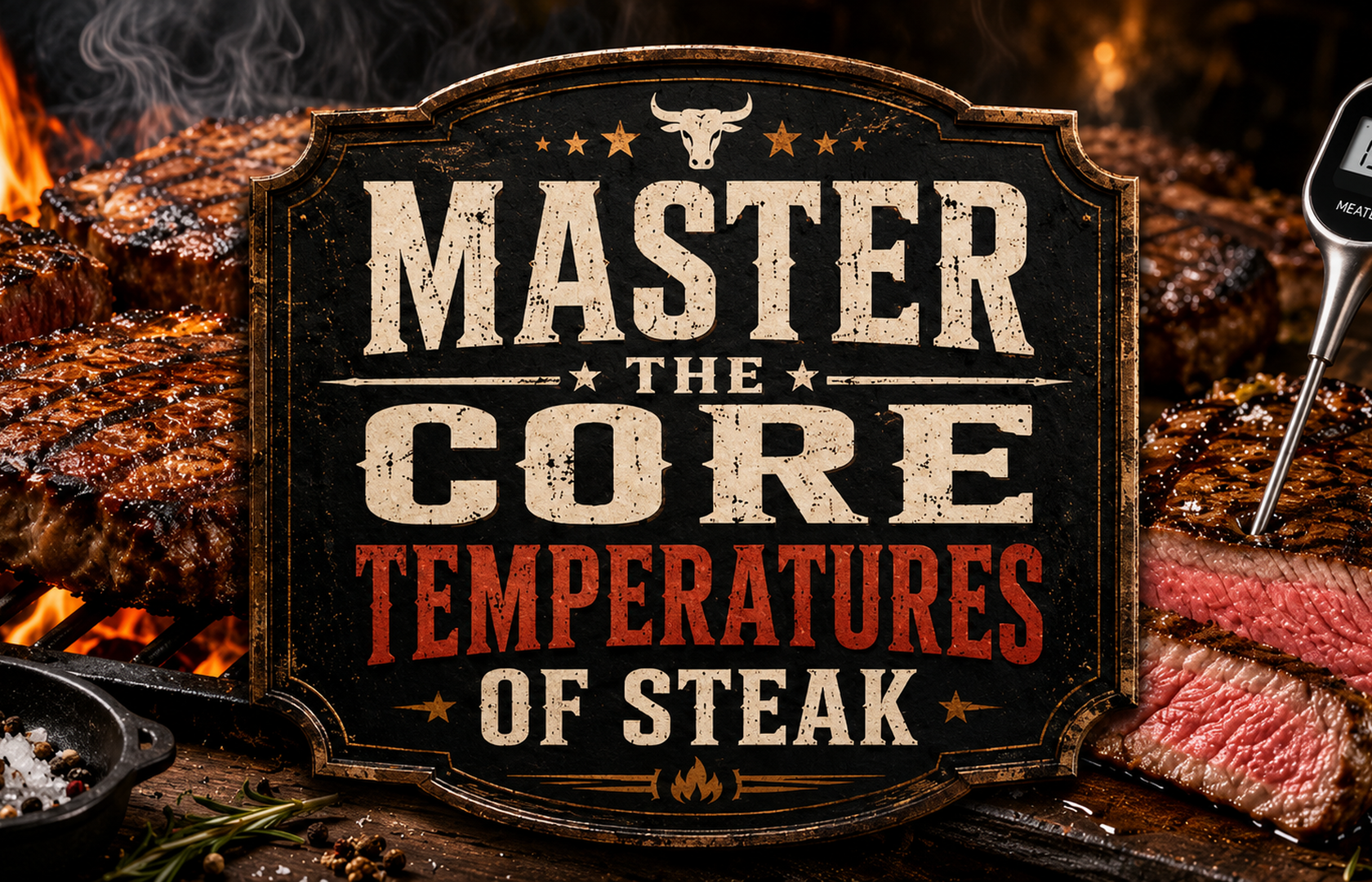
A great steak must be cooked to its exact internal target temperature to ensure optimal juiciness, flavor release, and muscle fiber tenderness.
Backyard grilling completely changes once you understand the precise science of heat transfer and internal moisture retention.
Relying on simple timing rules or pressing down on the meat with your thumb will often leave your expensive ribeyes completely overcooked or dangerously raw in the center.
Knowing the exact thermal limits allows you to pull your beef off the open fire pot at the perfect moment every single time.
This basic mastery completely changes your final results when cooking over hot charcoal or gas flames.
The interior proteins react consistently to rising temperatures, shifting from soft and red to firm and brown as the proteins tighten up and release their internal juices.
If you pull the meat off the grill too early, the interior fat will not melt completely, leaving you with a chewy texture.
Pull it off too late, and the valuable juices evaporate entirely, leaving the beef dry and tough.
By focusing on scientific target ranges, you can deliver steakhouse quality results on your home patio deck.
How We Tested and Tracked Meat Doneness
Our evaluation process focused heavily on internal temperature accuracy, core moisture levels, and the natural rise of carryover cooking.
We cooked dozens of thick-cut New York strips and ribeyes across various grill styles, using highly precise digital probes to track how the internal meat climate changes after you remove the beef from the direct flames.
We measured the exact volume of juice lost during cutting and recorded the final firmness of the meat fibers at every distinct stage of doneness.
We also looked closely at how different external cooking methods affect the internal color gradient of the meat.
A slow reverse-sear method creates a highly uniform color from edge to edge, while a fast high-heat sear on a cast-iron skillet creates a dark outer band with a progressive shift in the middle.
Every level of doneness was evaluated based on its physical properties, its tenderness ranking, and how easy it is to manage for backyard beginners using standard tools.
The Rare Baseline: Cool, Red, and Juicy
A rare steak represents the absolute baseline of minimal cooking, designed specifically for people who want the softest texture and the highest amount of natural juice.
At this stage, the internal temperature of the beef sits strictly between 120°F and 130°F.
The very center of the meat remains completely bright red and noticeably cool to the tongue, as the heat has only traveled far enough to warm the outer layers of the muscle tissue.
Because the interior proteins have barely been exposed to heat, they remain completely uncoiled and highly relaxed.
This lack of tension means the steak feels incredibly soft when you press down on it with a fork.
While rare steak is exceptionally juicy, it does not allow the rich pockets of intramuscular marbling to melt completely.
This makes it an ideal choice for lean, tender cuts like beef tenderloin or filet mignon, which do not rely on heavy fat rendering for their flavor.
The Medium Rare Sweet Spot: Warm Red Center
Medium rare is the widely accepted standard for premium steak because it strikes a flawless balance between melting internal fat and retaining natural meat juices.
This level is achieved when the internal core temperature hits between 130°F and 135°F.
The interior displays a warm, rich red center that transitions gracefully into a light pink band near the outer seared crust of the meat.
This specific thermal zone is where the magic happens for highly marbled cuts like ribeyes and strip steaks.
The heat rises just enough to melt the white pockets of intramuscular fat, turning them into a rich, savory liquid that coats the meat fibers from the inside out.
The muscle proteins begin to firm up slightly, giving the steak a satisfying chew while remaining incredibly tender.
It is the top choice for enthusiasts who want to maximize the rich flavor of high-grade beef.
The Medium Mark: Hot Pink and Firmer
Once a steak climbs into the medium range, the interior temperature reaches between 135°F and 145°F, causing a significant shift in both texture and appearance.
The center of the meat loses its bright red hue completely, replaced by a highly uniform, hot pink color throughout the entire core.
The steak feels noticeably firmer to the touch as the muscle fibers tighten up and begin pushing out a small portion of their internal moisture.
Medium cooking is an excellent choice for family gatherings where guests are uncomfortable seeing red juices on their plates but still want a tender, easy-to-chew meal.
Because the internal fat is completely liquefied at this stage, the steak still carries plenty of rich flavor.
However, you must monitor your heat closely here, as the window between a juicy medium steak and a dry, overcooked dinner is incredibly narrow when cooking over live charcoal.
The Medium Well Horizon: Mostly Gray with a Touch of Pink
A medium well steak moves closer to being completely cooked through, with the internal temperature climbing into the 145°F to 155°F range.
At this level of heat, the interior of the beef becomes predominantly grayish-brown, leaving only a faint sliver of pale pink running directly through the absolute center of the thickest part of the meat.
The structural changes inside the meat are quite severe at this temperature line.
The muscle fibers contract tightly, causing the steak to shrink in size and release a substantial amount of its natural clear juices onto the grill grates.
The exterior crust becomes much thicker and drier, requiring a strong cutting stroke with a serrated knife.
It is a preferred level for people who prioritize food safety appearances above raw tenderness, though it requires a highly marbled cut to prevent the meat from turning unpleasantly chewy.
The Well Done Finish: Completely Cooked Through
Well done is the final stage of the cooking spectrum, reached when the internal temperature of the beef passes 155°F and moves higher.
The interior of the steak turns entirely grayish-brown from edge to edge, with absolutely no traces of pink or red left in the tissue.
The internal fat and moisture have been completely baked out of the meat, leaving the muscle fibers tightly packed and highly compressed.
A well done steak feels completely solid and rigid when pressed with a pair of tongs.
Because there are no internal liquids left to lubricate the muscle strands, chewing a well done steak requires significantly more effort.
To ensure a good experience at this level, you should look toward thin cuts or utilize heavy marinades beforehand to help break down the tough protein bonds before the meat ever touches the hot metal cooking grates.
Five Top Temperature Competitors and Tools for Accuracy
To achieve these specific levels of doneness consistently, you need a high-quality temperature tracking tool.
We evaluated five top competing digital systems designed to help backyard cooks measure internal heat accurately without guessing.
1. Thermapen ONE by ThermoWorks
The Thermapen ONE is the undisputed gold standard for professional instant-read speed and accuracy in the grilling world.
It features a highly advanced thermocouple sensor that delivers a rock-solid temperature reading in exactly one second or less.
The bright, auto-rotating backlit screen makes it incredibly easy to read your numbers while leaning over a hot, smoky grill box.
Check current availability through the product listing below.
Buy Thermapen ONE on Amazon ↗️
2. Weber Connect Smart Grilling Hub
The Weber Connect Smart Grilling Hub is a highly integrated digital assistant that transforms any standard grill into a smart cooking station.
It uses wired probes that slide directly into your steak, sending continuous temperature updates straight to your smartphone via Bluetooth or Wi-Fi.
The app features step-by-step cooking programs that tell you exactly when to flip your meat and when to pull it off to rest.
Check current availability through the product listing below.
Buy Weber Connect Smart Grilling Hub on Amazon ↗️
3. Typhur InstaProbe
The Typhur InstaProbe is a premium, heavy-duty instant-read competitor featuring a sleek digital display and a water-resistant body.
It utilizes direct-contact sensor technology to deliver accurate internal numbers in less than one second, making it incredibly useful when managing multiple steaks across a wide cooking surface.
Check current availability through Amazon search below.
Buy Typhur InstaProbe on Amazon ↗️
4. Inkbird IBT-4XS Bluetooth Wireless Thermometer
The Inkbird IBT-4XS is an exceptional, value-focused choice for budget-conscious grillers who want multi-probe tracking without a high cost.
It comes with four color-coded wired probes and a rechargeable base station, allowing you to monitor up to four individual steaks at different targets simultaneously using a simple phone app.
Check current availability through Amazon search below.
Buy Inkbird IBT-4XS on Amazon ↗️
5. ThermoPro TP19H Digital Meat Thermometer
The ThermoPro TP19H is a fantastic, straightforward entry-level instant-read tool that delivers fast, accurate readings on a tight budget.
It features a long, folding stainless steel probe that keeps your hands safe from rising heat, alongside a simple gravity-sensor display that clears up your view at awkward viewing angles.
Check current availability through the product listing below.
Buy ThermoPro TP19H on Amazon ↗️
Key Structural Signs of Accurate Doneness
While digital probes are the most accurate tool, understanding the physical feedback of the steak will help you understand how the meat behaves under intense heat.
As beef cooks, the clear liquids inside the cells expand and push toward the cooler parts of the meat.
When a steak sits on a hot grill, you will see small beads of clear moisture start pooling on the raw top surface, which tells you that the heat is successfully pushing through the core from the bottom.
The resting phase is another critical structural element that directly impacts your final doneness level.
When you pull a hot steak off the grill, the interior temperature will naturally continue to rise by another 2°F to 5°F due to residual heat trapped in the outer crust.
Skipping the resting period causes all the compressed internal juices to run straight out onto your cutting board, turning a perfectly medium rare steak dry and tough in a matter of seconds.
Honest Critiques: Real-World Flaws of Every Top Method
No single method for measuring doneness is absolutely perfect, and every tool carries distinct real-world limitations you must consider.
| Method | Real-World Flaw |
|---|---|
| Instant-Read Probes | They give you lightning-fast data, but you have to manually open your grill lid constantly to check the meat, which lets valuable wood smoke and hot air escape from the cook box. |
| Leave-In Wired Hubs | They provide wonderful continuous tracking data, but the thin silver wires can easily tangle up in your storage drawer or get pinched and ruined by heavy iron lids. |
| The Touch Test Method | Relying on the firmness of your hand requires years of daily kitchen practice to master, making it highly unreliable for beginners who are dealing with varying thicknesses of beef. |
| Visual Slicing | Cutting into the center of a cooking steak lets you see the color instantly, but it creates a deep wound that drains away the internal juices, drying out the meat before it finishes cooking. |
| App-Based Time Estimators | Smart cooking apps provide excellent rough timelines, but they cannot account for unexpected backyard wind gusts or sudden charcoal flare-ups that change your cooking speeds. |
The Final Verdict on Perfect Grilling Results
For the vast majority of backyard grillers who want absolute precision and restaurant-grade steaks every single weekend, investing in a high-speed instant-read tool like the Thermapen ONE is the best choice you can make.
If you prefer to sit inside the house while your meat slowly comes up to temperature, a multi-probe tracking system like the Weber Connect Hub will serve you beautifully.
Learn your target numbers, always let your meat rest before carving, and enjoy perfectly juicy results on every single cook.
P.S. - If you are ready to put your temperature tracking skills to the test with a massive backyard barbecue project, the Traeger Woodridge pellet grill shows how automated pellet cookers hold steady low temperatures for perfect all-day smoking.
Every Easy Function product ships with a free lifetime replacement warranty.