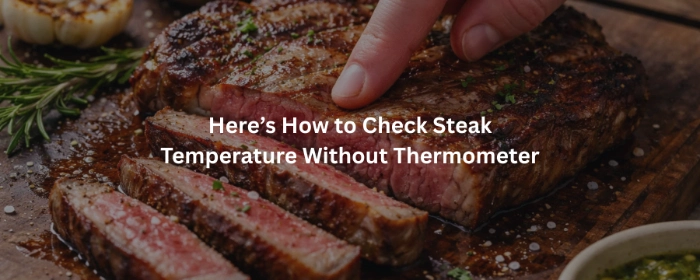
Here’s How to Check Steak Temperature Without Thermometer
-
Why You Might Not Have a Thermometer
-
The Finger Test: Most Popular Method
-
Using Cooking Time as a Guide
-
Watch the Steak Surface
-
Check the Juices, Not the Color Alone
-
Thickness Changes Everything
-
Practice Makes It Easy
-
Common Mistakes to Avoid
-
Final Thoughts on Checking Steak Temperature Without Thermometer
Disclosure: Some of the links in this article may be affiliate links, which can provide compensation to me at no cost to you if you decide to purchase. This site is not intended to provide financial advice and is for entertainment only.
Cooking steak without a thermometer can feel stressful.
You want it juicy, safe, and cooked just right.
The good news is this skill is older than thermometers.
Long before gadgets, cooks learned how to check steak temperature using simple signs like touch, time, and sight.
This guide explains here’s how to check steak temperature without thermometer in a clear, easy way.
These methods work on the grill, stovetop, or even over a campfire.
With a little practice, you can tell rare from well-done without cutting your steak open.

Why You Might Not Have a Thermometer
Sometimes the thermometer is missing.
Sometimes the battery is dead.
And sometimes you just want to cook like a pro who trusts their hands and eyes.
Learning how to check steak temperature without a thermometer helps you cook with confidence, whether you are using a full-size backyard grill, a small indoor setup, or even something portable.
Many people ask if compact or quick grill options are worth it.
If you enjoy experimenting with different cooking setups, you may also like reading Is a Disposable Instant BBQ Grill Worth the Hype? to see how well these grills handle real cooking.
These thermometer-free methods help you:
Cook faster without tools
Avoid poking holes that let juices escape
Build confidence at the grill
Handle last-minute cooking situations
These methods are not guesses.
They are time-tested ways people still use every day.
The Finger Test: Most Popular Method
The finger test compares the feel of steak to the feel of your hand.
Steak gets firmer as it cooks.
Your hand already knows these textures.
Touch your thumb to your index finger.
Now press the soft pad below your thumb with your other hand.
That softness matches rare steak.
Touch your thumb to your middle finger and press again.
That firmer feel matches medium-rare steak.
Touch your thumb to your ring finger.
That firmness feels like medium steak.
Touch your thumb to your pinky finger.
That tight firmness matches well-done steak.
Now gently press the center of your steak with a finger or tongs.
Compare the feel.
Do not press hard.
Just a light touch is enough.
This method works best with boneless steaks like ribeye, strip, or sirloin.
Using Cooking Time as a Guide
Time is another strong clue.
While steak thickness and heat matter, timing gives you a good range.
On high heat, a one-inch steak usually takes:
About 2 minutes per side for rare
About 3 minutes per side for medium-rare
About 4 minutes per side for medium
About 5 minutes per side for well-done
Flip only once if you can.
Constant flipping makes timing harder.
Always rest your steak for five minutes after cooking.
Resting lets heat finish the job and juices settle.
These timing rules work on most grills, including compact and tabletop models.
If you cook steak indoors or enjoy sharing grilled food at the table, you may also find Top Tabletop Grills for Korean BBQ at Home helpful for choosing the right setup.
Watch the Steak Surface
Your steak gives visual clues while it cooks.
Rare steak looks deep red inside and soft on the outside.
The surface browns fast, but the inside stays very soft.
Medium-rare steak shows a warm red center.
Juices bead on top.
The steak springs back slightly when pressed.
Medium steak has a pink center and firmer edges.
Less juice appears on the surface.
Well-done steak looks brown all the way through.
It feels tight and releases little juice.
Do not cut into the steak while cooking.
That releases juices and dries it out.
Visual checks work best along with touch.
Check the Juices, Not the Color Alone
Juice color matters more than meat color.
Rare steak releases dark red juice.
Medium-rare steak releases pink juice.
Medium steak releases light pink or clear juice.
Well-done steak releases almost no juice.
If juices run fast and clear, your steak is likely cooked through.
Thickness Changes Everything
Thicker steaks need more time.
Thin steaks cook fast and can jump from perfect to overdone in seconds.
For thick steaks, lower heat after searing helps cook the inside evenly.
Use touch and time together instead of one method alone.
Bone-in steaks cook slower near the bone.
Press the center, not the edge, for better accuracy.
Practice Makes It Easy
The first few times may feel unsure.
That is normal.
After a few cooks, your fingers learn the difference fast.
Try cooking two steaks at once.
Check one early and leave the other longer.
Compare the feel.
This builds skill quickly.
Many grillers keep a simple meat temperature chart nearby for reference, even when not using a thermometer.
Something like the Easy Function Meat Temperature Guide magnet can act as a quick visual reminder of doneness levels without interrupting your cooking flow.
It does not replace skill, but it supports learning.
Common Mistakes to Avoid
Pressing too hard flattens the steak and gives false firmness.
Checking too early before the crust forms leads to guessing.
Cutting into the steak ruins moisture and heat balance.
Cooking cold steak straight from the fridge slows even cooking.
Let steak sit out for 20 minutes before cooking for best results.
Final Thoughts on Checking Steak Temperature Without Thermometer
Knowing here’s how to check steak temperature without thermometer gives you freedom at the grill.
You stop relying on tools and start trusting your senses.
Touch tells you firmness.
Time gives you a range.
Juices and appearance confirm doneness.
Together, these methods work extremely well.
Many experienced cooks prefer them over gadgets.
If you enjoy grilling and want to make cooking easier, you can also explore our range of simple BBQ tools and guides.
Click the image on this page to check out our products and see what fits your grill style best.
-
Why You Might Not Have a Thermometer
-
The Finger Test: Most Popular Method
-
Using Cooking Time as a Guide
-
Watch the Steak Surface
-
Check the Juices, Not the Color Alone
-
Thickness Changes Everything
-
Practice Makes It Easy
-
Common Mistakes to Avoid
-
Final Thoughts on Checking Steak Temperature Without Thermometer
Disclosure: Some of the links in this article may be affiliate links, which can provide compensation to me at no cost to you if you decide to purchase. This site is not intended to provide financial advice and is for entertainment only.