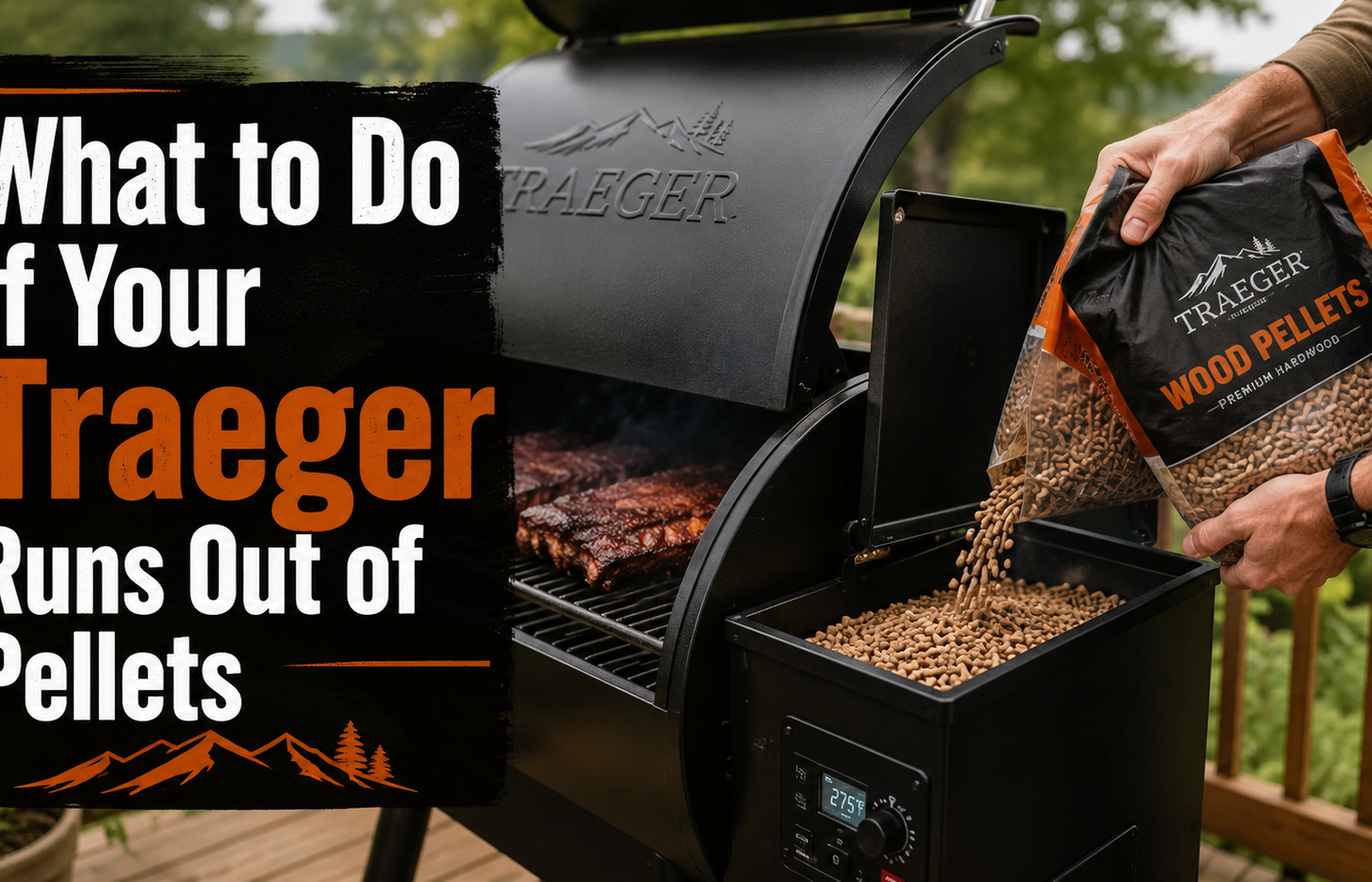
Running out of pellets mid-cook is one of the most common pellet grill mistakes.
It usually happens during long brisket or pork shoulder cooks when fuel burns faster than expected.
The good news: it’s fixable.
The bad news: you can’t just pour more pellets in and pretend nothing happened.
Here’s exactly what happens, and what to do next.
Subscribe to Our YouTube Channel :)
What Happens If a Traeger Runs Out of Pellets?
When your Traeger runs out of pellets, the fire in the firepot dies.
The fan may still run.
The auger may still turn.
But without fuel, there’s no heat.
You’ll notice:
-
Temperature dropping quickly
-
Thick white smoke (sometimes)
-
An error code on newer models
-
The grill shutting itself down
If pellets run out completely, the firepot may fill with unburned pellets once you refill and restart.
That’s why relighting correctly matters.
Buy Traeger Signature Hardwood Pellets on Amazon ↗️
Step 1: Don’t Panic – Check the Hopper
Open the hopper and confirm it’s empty or nearly empty.
If there are just a few pellets left, top it off immediately with dry, fresh pellets like the Traeger Signature pellets.
If the grill only dipped slightly in temperature and didn’t fully shut down, you may be able to continue cooking without a full restart.
But if the fire completely went out, move to the next step.
Read Next: Can You Use Pit Boss Pellets in a Traeger Grill? What Actually Works
Step 2: Turn the Grill Off Completely
Do not simply add pellets and crank the temperature back up.
Turn the grill off and allow it to finish its shutdown cycle.
Let it cool slightly before restarting.
This prevents excess pellets from piling up in the firepot.
Buy Traeger Signature Hardwood Pellets on Amazon ↗️
Step 3: Check the Firepot
This is the step many people skip.
If pellets ran out during operation, the auger may have continued feeding for a short time.
That can leave partially burned or raw pellets in the firepot.
Open the grill and inspect the firepot area.
If it’s packed with pellets, vacuum them out before restarting.
A small shop vac works well for this.
Skipping this step can cause:
-
Flare-ups
-
Thick startup smoke
-
Error codes
-
Sudden temperature spikes
A clean firepot ensures a clean relight.
Read Next: Are Traeger Pellets Toxic? What You Need to Know
Step 4: Restart the Grill Properly
Once the hopper is refilled and the firepot is clear, restart the grill as you normally would.
Let it preheat fully before putting food back in.
This may take 10–15 minutes.
If your food sat in the grill during the shutdown and internal temperature stayed in a safe range, you can continue cooking.
If the grill was off for an extended time and meat temperature dropped below safe levels, food safety rules apply.
Buy Traeger Signature Hardwood Pellets on Amazon ↗️
Will Running Out of Pellets Damage the Grill?
Occasionally running out of pellets won’t damage your grill.
However, repeated flameouts can cause:
-
Excess pellet buildup
-
Ignition strain
-
More frequent cleaning
Pellet grills are designed for steady fuel flow.
Interruptions just create extra work.
Read Next: How to Remove Pellets from a Traeger (The Clean, Simple Way)
How to Prevent It From Happening Again
Pellet burn rate depends on temperature.
At 225°F, most grills burn about 1 pound per hour.
At higher temps, that number can double or triple.
A standard 20-pound bag can last:
-
Up to 20 hours at low heat
-
As little as 6–10 hours at high heat
Before long cooks, fill the hopper completely.
During extended sessions, check pellet levels every few hours.
Some newer Traeger models include low-pellet sensors.
But visual checks are still smart.
Buy Traeger Signature Hardwood Pellets on Amazon ↗️
Flaws but Not Dealbreakers
One drawback of pellet grills is that you can’t always see fuel levels easily.
Unlike charcoal, pellets sit inside a hopper with walls around them.
It’s easy to forget to check.
Also, relighting takes longer than simply adding charcoal to a live fire.
You must follow the restart process carefully to avoid flare-ups.
That said, once you build the habit of checking pellet levels, flameouts become rare.
Read Next: Which Are the Best Grill Pellets? One Great Pick, Plus 2 Alternatives
The Bottom Line
If your Traeger runs out of pellets, the fire goes out.
The fix is simple: refill the hopper, clear the firepot if needed, and restart properly.
It’s not a disaster.
It’s just a reminder that pellet grills need fuel management like any other live-fire cooker.
Keep pellets dry. Keep the hopper full.
And long cooks will stay steady from start to finish.
Every Easy Function product ships with a free lifetime replacement warranty.