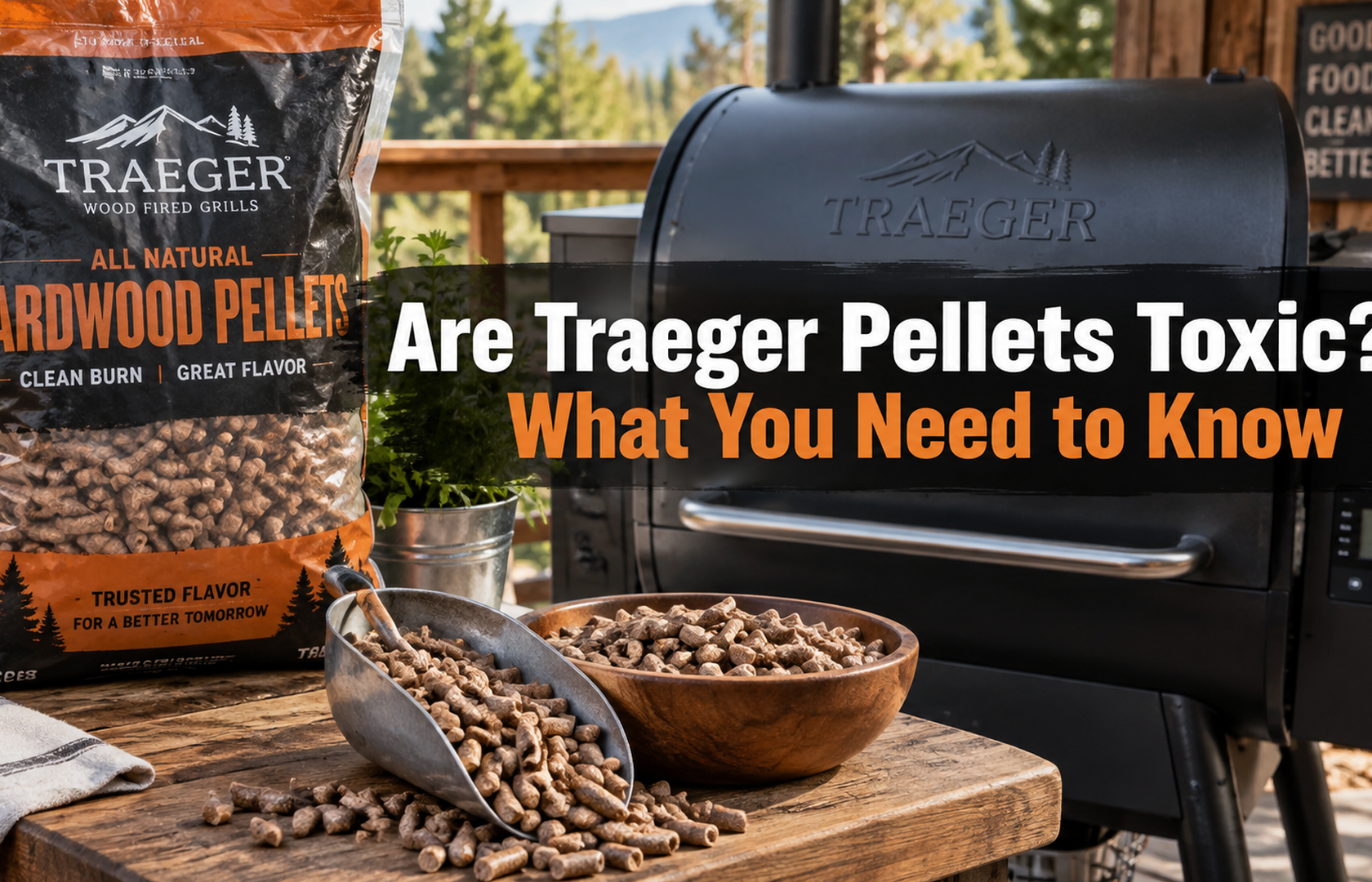
Short answer: No, Traeger pellets are not toxic when used as intended for cooking.
But that simple answer deserves context.
When people ask this question, they usually mean one of three things:
-
Are the pellets safe to use?
-
Is the smoke harmful?
-
Are there chemicals in the pellets?
Let’s walk through each one clearly.
Subscribe to Our YouTube Channel :)
What Are Traeger Pellets Made Of?
Traeger pellets are made from compressed hardwood sawdust.
They are marketed as 100% hardwood with no added fillers or binding agents.
Buy Traeger Signature Hardwood Pellets on Amazon ↗️
The pellets hold together because of lignin, a natural compound found in wood.
When heated and compressed, lignin acts like glue.
No artificial binders are required.
That matters because heating pellets, used for home furnaces, can contain softwoods or additives.
BBQ pellets are different.
They’re manufactured specifically for cooking food.
When you buy food-grade pellets from a reputable brand, toxicity from ingredients is not a concern.
Read Next: What Are Traeger Pellets and Why Do They Matter
What About the Smoke?
This part needs a bit more explanation.
Burning wood produces smoke.
Smoke contains compounds like carbon monoxide, particulate matter, and polycyclic aromatic hydrocarbons (PAHs).
These are natural byproducts of combustion.
That doesn’t make pellet grilling uniquely dangerous.
The same compounds are present when cooking over charcoal, wood splits, or even a campfire.
Pellet grills actually tend to burn cleaner than traditional offset smokers because:
-
Combustion is controlled by a fan
-
Temperature is regulated digitally
-
Pellets have low moisture content
Cleaner combustion usually means thinner, lighter smoke.
However, any grill should be used outdoors or in well-ventilated spaces.
Carbon monoxide is odorless and dangerous in enclosed areas.
That’s not specific to Traeger pellets it applies to all live-fire cooking.
Discover Next: Are Smoked Vegetables Bad for You? Find Inside!
Are There Chemicals in Traeger Pellets?
Food-grade hardwood pellets are not supposed to contain:
-
Chemical accelerants
-
Artificial flavor sprays
-
Glue or binding agents
-
Recycled treated lumber
Reputable brands use kiln-dried hardwood sourced for cooking use.
That’s very different from scrap wood or construction lumber.
If you ever see pellets labeled for “heating” only, avoid them for cooking.
Those are not food-safe.
As long as you stick to BBQ-labeled pellets, you are using a product designed for food preparation.
Buy Traeger Signature Hardwood Pellets on Amazon ↗️
Is Pellet Grill Food Safe to Eat?
Yes when cooked properly.
The bigger health factors in grilled food usually come from:
-
Cooking at very high temperatures
-
Excess charring
-
Fat dripping and flaring
Pellet grills reduce flare-ups compared to direct-flame grilling because a heat deflector sits between the firepot and the food.
That indirect heat design can actually lower the risk of heavy charring compared to open charcoal flames.
As with any cooking method, moderation and proper technique matter more than the fuel source alone.
Read Next: How Long Does It Take to Smoke a Pork Shoulder on a Pellet Grill
When Could Pellets Become Unsafe?
There are a few situations where problems can happen.
If pellets absorb moisture and begin to mold, you should not use them.
Mold spores can contaminate the hopper and affect smoke quality.
If pellets are contaminated with debris or foreign material, discard them.
And if you store pellets near chemicals like gasoline or solvents, they can absorb odors.
Wood is porous.
Keep them sealed and stored properly.
None of these risks are unique to Traeger.
They apply to all hardwood pellets.
Buy Traeger Signature Hardwood Pellets on Amazon ↗️
Flaws but Not Dealbreakers
Even though Traeger pellets are not toxic, burning wood — any wood — creates smoke particles.
If you are highly sensitive to smoke or have respiratory issues, extended exposure may cause irritation.
Pellet grills are not “smoke-free.”
They are simply more controlled.
Also, while premium pellets aim for clean hardwood sourcing, no manufacturing process is perfect.
Quality control matters.
That’s one reason sticking to reputable brands is important.
Read Next: Where to Buy Traeger Pellets (And Where You’ll Get the Best Value)
The Bottom Line
Traeger pellets are not toxic when used correctly.
They are made from food-grade hardwood and designed specifically for cooking.
The real safety rules are simple:
Use BBQ-grade pellets.
Cook outdoors.
Store pellets dry.
Avoid excessive charring.
Follow those basics, and pellet grilling is no more toxic than traditional charcoal or wood cooking.
In many cases, it’s cleaner and more controlled.
The concern isn’t the brand.
It’s how the pellets are used.
Buy Traeger Signature Hardwood Pellets on Amazon ↗️
P.S. - Wondering how long your pellets will actually hold up? Before you stock up, read our latest guide: How Long Do Traeger Pellets Last? (Storage + Burn Time Explained). It breaks down shelf life, burn rates, and simple storage tips so you don’t waste fuel — or ruin a long cook.
Every Easy Function product ships with a free lifetime replacement warranty.