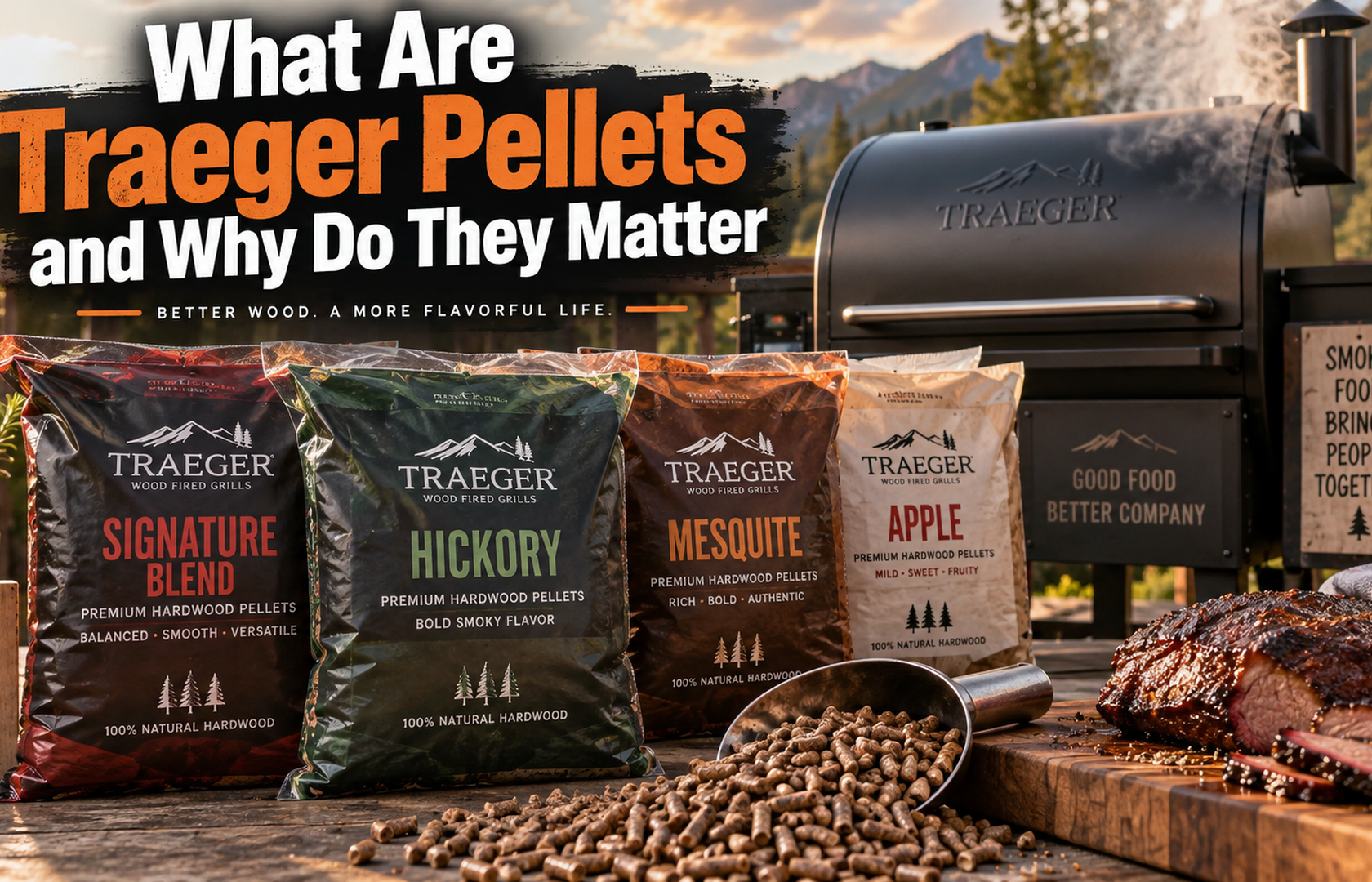
Traeger pellets are compressed hardwood sawdust made to fuel pellet grills.
They create both heat and smoke flavor.
If you own a pellet grill, especially a Traeger, these pellets are the engine behind every brisket, burger, and rack of ribs you cook.
Buy Traeger Signature Hardwood Pellets on Amazon ↗️
Subscribe to Our YouTube Channel :)
A good wood pellet should burn hot, burn clean, and produce steady smoke.
It should not crumble in your hand.
It should not leave piles of ash in your firepot.
And it should add flavor without overpowering your food.
Traeger pellets are designed to check those boxes.
But there’s more to understand before you fill your hopper.
What Are Traeger Pellets Made Of? (Materials and Manufacturing)
Traeger pellets are made from 100% hardwood.
That means no fillers, no binding agents, and no artificial flavors.
The pellets hold their shape because of natural lignin, a compound in wood that acts like glue when heated and compressed.
Here’s how they’re made:
-
Hardwood is dried to remove moisture.
-
The wood is ground into fine sawdust.
-
The sawdust is compressed under high pressure.
-
Heat activates the lignin, forming dense, uniform pellets.
The result is a small cylinder about the size of a pencil eraser.
Why that matters:
-
Low moisture means better ignition.
-
High density means longer burn time.
-
Uniform size means consistent feeding through the auger system.
Cheap pellets often contain softwoods or additives.
Those burn faster and can produce bitter smoke.
Traeger’s formula aims to avoid that problem.
Check Traeger Signature Pellets’ Price on Amazon ↗️
How Pellet Grills Use Wood Pellets
Pellet grills work differently from charcoal or gas grills.
Here’s the simple version:
-
You pour pellets into a hopper.
-
An auger feeds pellets into a firepot.
-
An electric rod ignites them.
-
A fan controls airflow and heat.
The grill’s controller adjusts how many pellets feed into the fire.
More pellets = more heat.
Fewer pellets = lower temperature.
Because the pellets create both fire and smoke, they control your food’s flavor profile.
That’s why pellet choice matters more than many beginners realize.
Read Next: Cook Pork Shoulder on a Pellet Grill: Time and Temp Guide
Traeger Signature Blend Pellets: A Closer Look
One of the most popular options is Traeger Signature Blend Hardwood Pellets.
These pellets mix three hardwoods:
-
Hickory
-
Maple
-
Cherry
The goal is balance.
Hickory brings bold smoke.
Maple adds mild sweetness.
Cherry gives a light, fruity finish and deeper color to meat.
Why we like this blend:
-
It works for almost anything – chicken, pork, beef, even vegetables.
-
It produces steady heat.
-
It creates a clean smoke flavor that isn’t harsh.
For new pellet grill owners, this blend is a safe starting point.
Buy Traeger Signature Hardwood Pellets on Amazon ↗️
But there’s a catch.
Because it’s a blend, you don’t control the exact ratio of each wood.
If you want a stronger hickory punch or pure cherry flavor, you may prefer single-species pellets instead.
Flavor Profiles: How Different Wood Types Affect Your Food
Not all smoke tastes the same.
Here’s a quick breakdown of common hardwood flavors used in pellet cooking:
-
Hickory – Strong, classic BBQ flavor. Great for brisket and ribs.
-
Cherry – Mild, slightly sweet, adds deep red color to meat.
-
Maple – Light and smooth. Good for poultry and pork.
-
Oak – Neutral and steady-burning. Often used as a base wood.
Signature Blend combines sweet and strong notes so your food doesn’t taste overly smoky.
For weeknight grilling, that balance is helpful.
For competition-style BBQ, you might want something more targeted.
Read Next: Learn How to Use Smoker for BBQ Grill Cooking
Heat Output, Burn Time, and Efficiency
A great pellet should do three things well: hold steady heat, burn clean, and leave minimal ash.
In our experience with pellets like the Traeger Signature Blend, you can expect:
-
Stable temperatures within 10–15°F of your set point (on a well-maintained grill)
-
Roughly 1 to 3 pounds per hour of pellet use depending on temperature
-
Low-and-slow (225°F): closer to 1 lb/hour
-
High heat (400°F+): closer to 2–3 lbs/hour
- Moderate ash production, assuming dry storage
The density of Traeger pellets helps them burn evenly.
That’s important during long cooks like brisket or pork shoulder.
A sudden dip in heat can stall your cook or dry out meat.
But there’s a trade-off.
Premium pellets often cost more per pound than budget brands.
Over a full summer of grilling, that difference adds up.
Check Traeger Signature Pellets’ Price on Amazon ↗️
Are Traeger Pellets Different from Other Brands?
On paper, most BBQ pellets look similar: compressed hardwood, no fillers, food-grade safe.
So what sets Traeger apart?
1. Brand consistency – Traeger tightly controls pellet size and moisture levels. That helps prevent auger jams and uneven feeding.
2. Widely available blends – Signature Blend is designed to be an all-purpose option. Many smaller brands focus on single-species pellets only.
3. Designed for compatibility – Traeger pellets are engineered specifically for Traeger grills. That doesn’t mean you can’t use other brands, but fit and performance are predictable with the same-brand pairing.
Now the flip side.
Some competitors offer:
-
Lower price per pound
-
Stronger, more distinct single-wood flavors
-
Larger bulk-buy options
If you run your grill weekly, cost per cook may matter more than brand alignment.
Common Questions
How long are Traeger pellets good for?
Traeger pellets do not expire. But they absorb moisture.
If pellets swell, crumble, or feel soft, they’re no longer safe to use.
Store them in a sealed container in a dry space.
Can you mix pellet flavors?
Yes. Mixing pellets in the hopper is common.
Many pitmasters blend stronger woods with milder ones to dial in flavor.
Are they safe for food?
Yes. Food-grade pellets are made from untreated hardwood.
Never use heating pellets meant for home furnaces.
Those may contain softwood or additives.
Do they work in non-Traeger grills?
Yes. Most pellet grills use standard-sized pellets. Always check your grill manufacturer’s guidance.
Read Next: Find Out How Often to Clean Pellet Grill
Flaws but Not Dealbreakers
No product is perfect.
Here’s where Traeger pellets fall short.
They cost more than some competitors.
You’re paying for brand reputation and quality control.
Flavor intensity is moderate.
Signature Blend is balanced, but not bold.
If you want heavy smoke flavor, you may find it too subtle.
Availability varies by location.
While widely stocked, certain blends may sell out during peak BBQ season.
None of these are dealbreakers.
But they’re worth knowing before you buy 80 pounds for the season.
Buy Traeger Signature Hardwood Pellets on Amazon ↗️
Who Should Buy Traeger Pellets and Who Shouldn’t
Good fit for:
-
New pellet grill owners
-
Anyone using a Traeger grill
-
Backyard cooks who want reliable, balanced smoke
-
Weeknight grillers who don’t want to overthink wood selection
Read Next: Clean Your Traeger Grill: The Best Method Guide
Not ideal for:
-
Competition BBQ teams chasing strong, specific smoke profiles
-
High-volume smokers looking to cut fuel costs
-
Grillers who prefer single-species wood flavor control
Final Thoughts
Traeger pellets are compressed hardwood fuel designed for steady heat and clean smoke.
They’re reliable, beginner-friendly, and easy to find.
The Signature Blend is especially versatile, working well across beef, pork, chicken, and vegetables.
They are not the cheapest pellets.
And they won’t give you the most aggressive smoke flavor.
But they offer predictable performance, which is often more important than extremes.
For most backyard cooks, that consistency is the real value.
Check Traeger Signature Pellets’ Price on Amazon ↗️
If you want simple, steady results without trial and error, Traeger pellets are a safe bet.
Until next time,
Ciao!
P.S. - We recently tested Traeger pellets head-to-head against two other top brands to find the best wood pellets. Read the full breakdown here: Best Grill Pellets: Top Pick Plus 2 Alternatives
Every Easy Function product ships with a free lifetime replacement warranty.