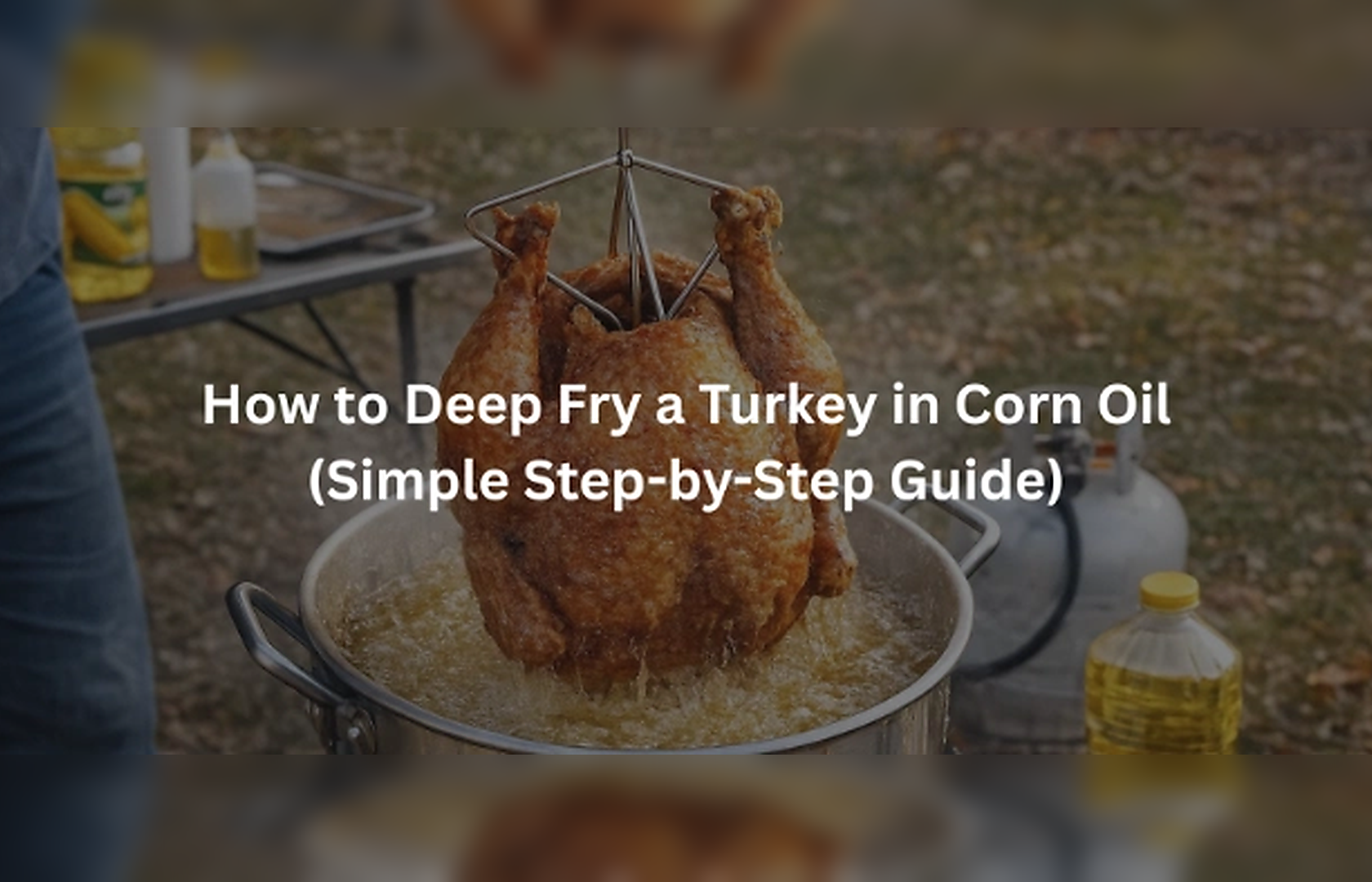
Deep frying a turkey in corn oil is a fast and tasty way to cook a whole bird.
The skin gets crisp.
The meat stays juicy.
The flavor is mild and clean.
Corn oil works well because it has a high smoke point and handles heat without burning.
This guide will show you how to do it in a safe and simple way.
Before you start, keep in mind that deep frying a turkey needs care.
Hot oil can be risky.
You must set up your space, check your tools, and follow each step.
Once you do it right, the results are worth it.
Subscribe to Our YouTube Channel :)
What You Need
You do not need much to deep fry a turkey.
You need a fryer pot, a burner, a full propane tank, corn oil, a thawed turkey, a hook or lifting tool, a thermometer, and a dry place to work outside.
A level surface helps keep the pot steady.
Corn oil is a good choice for turkey frying because it stays stable at high heat.
It also has a neutral taste that lets your seasoning stand out.
Many cooks pick it for big outdoor fry days because it performs well and heats evenly.
If you want a guide that focuses only on temperature and timing, you can check this helpful resource:
How to Deep Fry a Turkey? Temperature & Timing Guide:
Thaw the Turkey
A frozen turkey and hot oil do not mix.
Ice causes the oil to bubble up fast, and that can spill over.
That is why your turkey must be fully thawed.
A good rule is one day of thawing in the fridge for every four to five pounds of turkey.
When you think it is done, press the cavity; it should feel soft with no hard spots.
Pat the turkey dry with paper towels.
Make sure there is no extra water on the skin or inside the cavity.
Water droplets can cause popping once the bird touches the oil.
Measure the Oil Level
Before you fill the pot with corn oil, you need to know how much oil you will need.
Put the turkey in the empty pot.
Fill the pot with water until the bird is covered by about one inch.
Take the turkey back out.
Mark the water line; this tells you the oil level. Dump out the water and dry the pot.
Using this method keeps you from overfilling the pot.
When hot oil spills, it can cause fires.
Taking a few minutes to measure the level is one of the best safety steps you can take.
Season the Turkey
You can season the turkey any way you like.
Some people use a dry rub.
Others inject melted butter and herbs under the skin.
Simple salt and pepper work too.
Because deep frying cooks fast, bold flavors shine.
Make sure the seasoning sticks to the dry skin.
If you inject the turkey, inject small amounts in several spots so the flavor spreads.
Keep the skin dry when you finish.
At this stage, knowing the final cooked temperature helps.
Turkey must reach a safe internal temp.
One handy tool for this is the Easy Function Meat Temp Guide Magnet:
Buy Easy Function Meat Temp Guide - Amazon Canada
**
Buy Easy Function Meat Temp Guide - Amazon USA**
It lists clear poultry temperatures you can check at a glance while you cook.
Heat the Corn Oil
Bring the pot outside and set it on a stable burner.
Add corn oil up to the line you marked.
Turn on the burner.
Heat the oil to 350°F.
Use a thermometer to watch the temperature.
Good heat control keeps the turkey from burning on the outside while staying raw inside.
Corn oil handles heat well, so it will stay steady once it reaches the right temperature.
Be patient.
Do not rush by turning the burner too high.
For more cooking temp references, you may also like this chart:
Smoking Times & Temps Cheat Sheet: Quick Guide & Chart:
Lower the Turkey Slowly
When the oil reaches 350°F, turn off the burner for a moment.
This lowers the risk of flare-ups.
Hook the turkey on the lifting tool.
Lower it into the oil bit by bit.
You will hear a strong sizzle.
When the turkey is fully in the oil and settled, turn the burner back on.
Keep the oil between 325°F and 350°F the whole time.
Good temperature control gives you even cooking.
Fry Time
Deep frying does not take long.
A good rule is 3 to 3.5 minutes per pound.
A 12-pound turkey will take about 36 to 42 minutes.
Keep a thermometer handy to check the oil.
When you think the turkey is done, lift it a little and test the temperature in the thickest part of the breast and thigh.
It must reach 165°F to be safe to eat.
Check more than one spot to be sure.
Rest the Turkey
When the turkey is done, lift it slowly and let excess oil drip back into the pot.
Move it to a tray and let it rest for about 20 minutes.
Resting helps the juices settle so the meat stays moist when you slice it.
The skin will be deep golden and crisp.
The meat will be tender and full of flavor.
Corn oil gives a clean taste that pairs well with savory rubs.
Turn Off and Cool Down
When you finish, turn off the burner and let the oil cool fully before you move the pot.
Do not add water.
Do not try to pour hot oil into another container.
When cool, strain the oil to remove bits.
You can reuse corn oil a few times if it looks clear.
Final Thoughts
Deep frying a turkey in corn oil is simple when you follow each step.
Thaw the bird.
Dry it well.
Measure the oil.
Heat it slow.
Lower the turkey with care.
Watch the temperature.
These steps help you get a juicy turkey with crisp skin and great flavor.
If you want helpful tools for cooking or BBQ, feel free to explore our full range of Easy Function products.
Click the image to check them out.
P.S. - Before you follow How To Deep Fry A Turkey In Corn Oil: Simple Step By Step Guide, read Discover What Temperature To Deep Fry A Turkey. The right oil temp keeps your turkey crispy outside and juicy inside.
Every Easy Function product ships with a free lifetime replacement warranty.
![How Long to Barbecue Boneless Chicken Breast [Explained]](https://cdn.sanity.io/images/ulc97050/production/5f0e5a3bb35b5a88c92416fccb7177502cd477ca-1920x1080.png?w=3840&h=2160&fit=crop&auto=format&q=75)